Sunday, March 3, 1996

Why college costs so much

From the series Creating the Class of 2000


The economics of college is different from the ordinary economy.  The coin of universities is prestige.  Students and parents want to be graduated with the most prestigious degree they can get, believing that's the key to unlocking the doors to success. How do you gauge prestige? By how selective the school is -- and how expensive. Thus there's very little incentive to keep tuition prices low, but very powerful incentives for keeping them high. And plenty of customers out there, ready to pay the prices.

I tried to bring the phenomenon to life in this look at college admissions at one of the country's top-ranked schools.

(please click on images to enlarge)


Friday, December 22, 1995

Inside the admissions office: Thumbs up and thumbs down

From the series Creating the Class of 2000.

For this story, I got extraordinary access to sit in and the admissions committee decided who would be accepted for early decision. And who wouldn't.

(please click to enlarge image)


Monday, November 27, 1995

Penn in Las Vegas

Part of the series Creating the Class of 2000.

One of my favorite stories, following University of Pennsylvania recruiters as they sought Ivy League material at Caesar's Palace.

(Please click on images to enlarge. Right-click "Open Link in New Window" for best view)


Tuesday, August 8, 1995

That perennial: The college tour

From the series Creating the Class of 2000

After covering Higher Education for a while, I realized that perhaps the most important question about this world was access: who gets into the golden gates and who doesn't? Golden, because of the deeply rooted belief that going to a top-flight college provides a huge leg up on the ladder of life.  

It's a big story, and to illustrate it, I persuaded the University of Pennsylvania admissions office to let me hang out with them over the course of a year as they recruited students, received applications and decided the fates of all those hopeful high-schoolers. I got tremendous access. I even got to sit in with the admissions committee as it decided, behind closed doors, who made it and who didn't.

I published roughly one story a month for a year. Here's the first one, in which we see doctors, lawyers and hedge fund managers lead their children unto top-tier college campus to perpetuate a new generation of doctors, lawyers and hedge fund managers.

(please click on images to enlarge)


Sunday, May 14, 1995

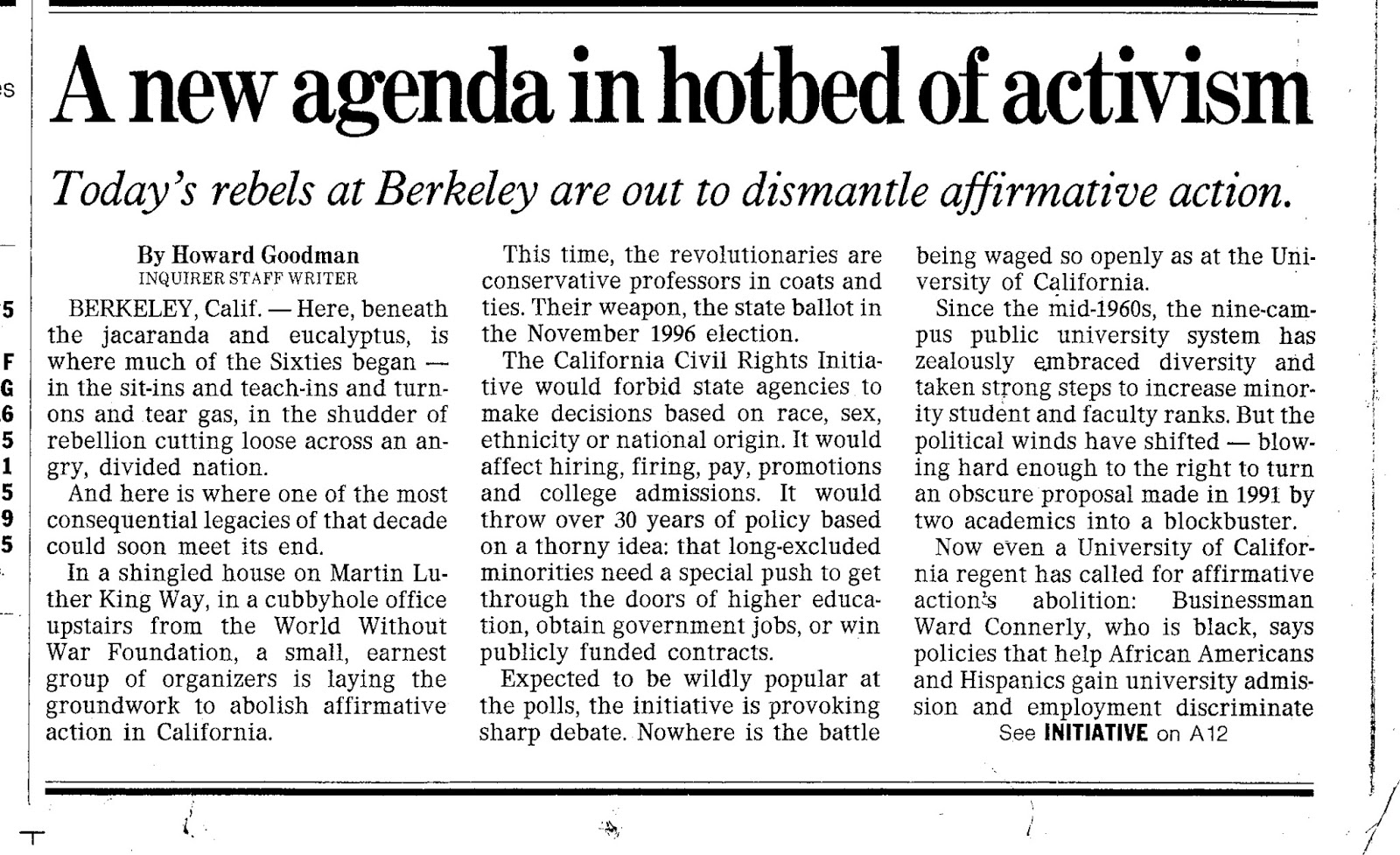
A backlash in Berkeley

Few issues are as thorny as Affirmative Action. 

Shouldn't society give a boost to African Americans, who have been held behind as a people by centuries of slavery and another century of Jim Crow and persistent poverty? 

But when that translates to preferential treatment in admissions to college, to take one of the most difficult battlegrounds, doesn't that lead to more unfairness, to those of other races who possess good qualifications but are denied entry? And might the boost not do some harm to the beneficiary, coming with an innate message that "you aren't good enough, without the handicap."

These issues played out in a convoluted way at the University of California in the 1990s. Once the center of leftist student radicalism, the university now became a spearhead to undo affirmative action.

I went out to Berkeley to write about it. A week after my front-page story appeared, the article was lauded by columnist Jonathan Yardley in the Washington Post, who called it "a balanced, comprehensive report."

(Please click on images to enlarge)